- Miaaw Monthly
- Posts
- Issue 42 | March 2026
Issue 42 | March 2026

Owen Kelly
March 04, 2026
Welcome to Miaaw Monthly: the monthly newsletter that comes out every month on the first Wednesday before the first Friday of the month. Confused? You will be.
And we should politely inform you that the newsletter arrives courtesy of Beehiiv.com - just in case you have any thoughts of doing your own newsletter and want to know who to approach.
Work on our new-this-year Podbean.com website continues at the speed of fairly nifty molasses, and the first visible fruits should arrive sometime towards the end of this month. Once we have the initial changes up and running we will start the laborious process of updating all the episode guides for our old podcasts to the new format.
And, if that isn’t enough, sometime last month we released our 300th podcast.
Miaaw is now officially too old to die young.
PODCASTS FOR MARCH 2026
Friday March 6
Meanwhile in an Abandoned Warehouse | Episode 84
In an episode called All the fun of Conscious Consumption, Owen Kelly delves into the history of “conscious consumption” and its cousin “ethical consumption” and, with his tinfoil hat on, asks whether they constitute a giant diversionary tactic aimed at keeping people busy while discouraging them from seeking the changes the will actually “make a difference”.
Spoiler: they sort of do.
Friday March 13
Parallel Streams | Episode 3
In the third episode of Parallel Streams, where we retransmit podcasts we think relate to Miaaw’s mission, Sophie Hope introduces and contextualises the final episode of Remember the Future Season 2 from art.coop.
What does it mean for philanthropy to exist in relationship to the solidarity economy? What if artists led a redistribution effort to resource arts collectives?
Friday March 20
A Culture of Possibility | Episode 62
In Episode 62 of A Culture of Possibility, Arlene Goldbard and François Matarasso talk about the nature of co-creation.
Co-creation is integral to community-based arts work.
What does it mean? What are its pitfalls? Why does it matter?
Friday March 27
Echoes and the Unsaid | Episode 3
In the third episode of Echoes and the Unsaid Jo Gibson and Sophie Hope meet John Sloboda (Emeritus Professor at Guildhall School of Music & Drama and Director of the Institute), Imogen Flower (researcher and evaluator), Toby Young (Professor of Composition at Guildhall School) and Maia Mackney (Public Engagement and Evaluation Manager at Guildhall School).
They discuss the history and nature of The Institute for Social Impact Research in the Performing Arts at Guildhall School - which ran from 2019 to 2023.
A THOUSAND WORDS
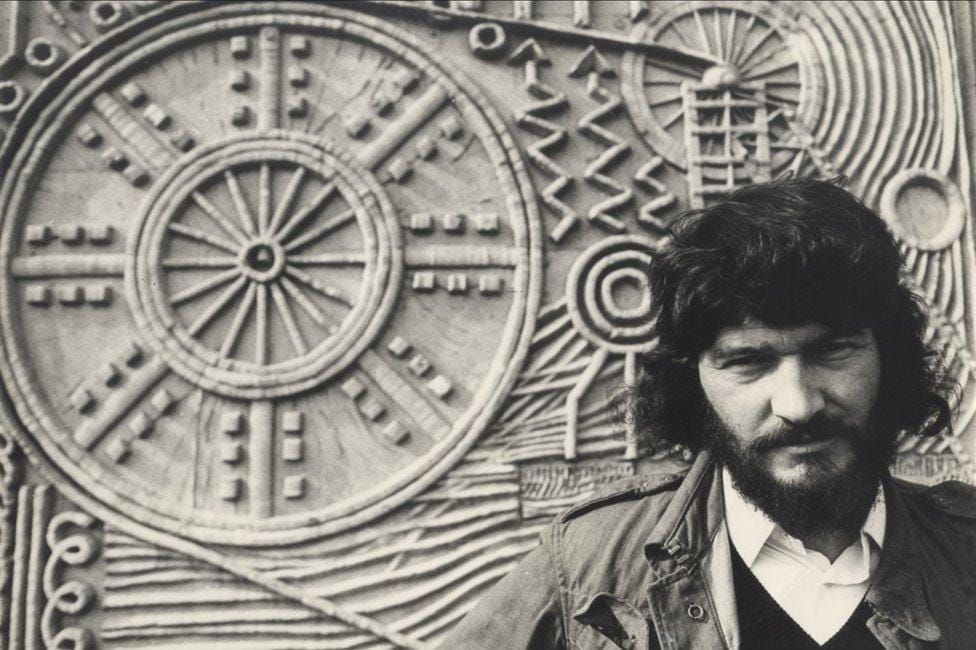
David Harding: a pivotal figure in the Scottish community arts movement.
THE WHOLE WIDE WORLD
David Harding (1937 - 2026)
We heard last week that David Harding, the man who more or less invented the idea of the town artist, has died. For those who don't know of him or his work, here is his description of his own areas of interest, borrowed from his website,
“Visitors and readers of this website will discern that my interests lie in the contemporary development of public art and social/political art in both practice and education; in practice, in terms of my own work and that of other artists; in education, in terms of how those practices can be taught in art schools; in particular my experiences working on the Art and Social Contexts course at Dartington College of Arts and then as founding Head of the Environmental Art course at Glasgow School of Art.”
You will find a fuller obituary of David at MemoriTree. There will be many other obituaries too.
Oh that David Rovics!
Somebody actually asked us, after listening to last month’s episode of Parallel Streams, how different David Rovics’ own performances of his songs are from the AI generated stuff he was talking about on the podcast.
Owen has found an example of exactly the same song performed by The Ministry of Culture (ie David Rovics and Kamala Emanuel: two voices and one guitar) and Ai Tsuno, his imaginary friends. The song is intended as an anthem to raise morale at demonstrations, although Ai Tsuno appears to have ignored that in favour of developing its own plans to enter the Eurovision Song Contest on behalf of Latvia.
Waste six minutes or less comparing the two versions on Owen’s personal website.
Minor Compositions
From Minor Compositions:
In what continues to be a turbulent and unsettling political times – marked by intensifying crises, hardening borders, and shrinking horizons – we want to hold open spaces for conversation, imagination, and collective thinking. The Minor Compositions podcast has always been about thinking together with authors whose work helps us name the present and sketch possible futures. We’re very happy to invite you to the next three live podcast recordings – conversations with authors about their recent books. These sessions are open, informal, and participatory. If you would like to join, listen in, and take part in the discussion, you are warmly welcome. All sessions begin at 7PM UK Time.
23 February, 7PM – Black Surrealist. The Legend of Ted Joans
With Steven Belletto. A conversation on the life and radical imagination of Ted Joans, Black surrealism, and the power of poetic insurgency – an exploration of how art and refusal open unexpected lines of flight.
9 March, 7PM – Communist Ontologies. An Inquiry into the Construction of New Forms of Life
With Bruno Gullì & Richard Gilman-Opalsky. A discussion on ontology and communism as living questions: how new forms of life might be constructed within and against the constraints of the present. Zoom link.
30 March, 7PM – Fables of Re-enchantment. Multiplicity, Imaginary, Revolution
With Stefania Consigliere. A conversation about multiplicity, the imaginary, and re-enchantment — and how revolutionary energies can emerge from storytelling, collective imagination, and renewed relations to the world. Zoom Link.
In difficult times, we believe it matters to gather – even virtually – to think together, to test ideas, to disagree generously, and to cultivate moments of hope and intellectual solidarity. We hope these conversations can offer not only analysis, but also sparks of possibility.
The Logging Off Movement is a scam
Taylor Lorenz founded UserMag.co, a tech and online culture newsletter. She has also written a book called Extremely Online: The Untold Story of Fame, Influence, and Power on the Internet.
She recently wrote this in her newsletter:
Over the past few years, a massive industry has emerged around dumb phones and the concept of logging off. From $400 minimalist dumb phones to influencers selling digital detox courses, logging off has become big business. Schools are banning phones. Politicians are blaming screen time. Media outlets are calling Gen Z “addicted.”
But is ditching your smartphone actually the answer? For my latest episode of Power User, I sat down with WIRED journalist Elana Klein to unpack the rise of the logging-off movement. We discuss how reasonable concerns over screen time have metastasized into a consumer movement selling $400 minimalist dumb phones for millions in profit.
We also dive deep into the anti-smartphone moral panic, which is heavily pushed by reactionary politicians and legacy media. We explore the history of our relationship with the internet, from the tech optimism of the early 2010s and the algorithmic shift in 2016 , to the dangerous reality of school phone bans that are leading to AI surveillance and increased police interactions for students.
We also talk about the concept of “smartphone addiction,” what it really means, and why your issues with technology are often manifestations of much larger societal problems.
You can see the video on YouTube. You can then decide how much of her arguments, if any, you wish to take on board.
Be aware that she is a hyperactive GenZ-style pundit, so you might find yourself feeling compelled to subscribe to her newsletter, or to fund her Substack, or to catch her on her YouTube channel, or…
Wherever you are, there she is. [insert emoji here]
Ireland’s basic income for artists became permanent
This comes from the February 14th edition of the Positive.News weekly newsletter.
A basic income scheme for artists that launched during the pandemic to kickstart Irish culture was made permanent this week.
Offering participants a weekly stipend of €325 (£283), the €25m (£21m) pilot helped more than 2,000 artists, although many more applied. According to an independent study, the scheme generated €100m (£87m) in “social and economic benefits” to Ireland’s economy.
Elinor O’Donovan (pictured) is among the artists to have been accepted onto the scheme, which was launched by the Irish government in 2022.
“Before I started receiving it, I was working part-time as a receptionist just to be able to afford my rent. I was thinking about moving to a country where I might be able to afford to live a bit cheaper,” she told Positive News.
“Now I work full-time as an artist. [The scheme] has given me the flexibility that the job of an artist requires and has allowed me to take risks. I’ve gone into film and I was able to pay other people to work with me on it.”
Although limited in scope, it’s the world’s first basic income scheme to be made permanent.
This serves as a good example of almost-UBI in action.
Some of us might think that the next step should involve widening its remit to make it available to everyone: to actually make it universal. Then those from the pool of “everyone” who wish to pursue a life as an artist will have the means to do so, as they should; as will those who wish to pursue a life of baking, dancing, mapping their local woods, or spending all day in a nearby pub.
Which, we might say, are also arts.
And next month…
The April edition of Miaaw Monthly will appear in your inbox on Wednesday, April 1 with the first podcast of the month arriving just two days later.
Believe that and you’ll believe anything!